Friday, December 2, 2016

Topic #11: Field Trip

The National Museum of African American History and Culture in Washington, D.C. should be a required field trip for every American. Ironically, most people will not have the means or ability to see it. 

My unearned privilege allows me to take time off work without losing my job and to earn enough money to travel for pleasure, so I consider it my duty to report back to those who won't be able to make it to the museum in person. 

I hope this virtual field trip gives you a small taste of the experience. The footage here only captures about 1% of the content of the museum, and fails to invoke the emotion that the museum's curators expertly created with light, space, and sound. 

These are the photos I managed to take in the six hours I spent at the museum, with you in mind. 

Enjoy.


Thursday, November 24, 2016

Topic #10: Thanksgiving: Breaking Bread and Breaking White Silence

It happens every year. I start to think about planning for the holidays in October, then I blink and suddenly Thanksgiving is on my doorstep. BAM! It's on. 

So here we are already. Today is Thanksgiving Day in the U.S. and you've got important things to do, like stick your hand up a poor turkey's backside and referee a potential family civil war over dinner, so I won't waste any time getting right to it. Here is...

The Official Showing Up for Racial Justice (SURJ) Guide to Surviving Thanksgiving

Thanksgiving Day Discussion Guide: Real conversations about race won't be easy, so you may need some help with talking points. SURJ has you covered with a discussion guide that will help you navigate tough conversations, as well as some questions you can ask to elicit feedback and avoid causing others to shut-down. Click here for the discussion guide!

Thanksgiving Day Hotline: If you followed the guide but you still find yourself in an unmanageable conversation, excuse yourself to the bathroom and simply text SOS (with no quotation marks!) to 82623, and they’ll send you more key talking points that tend to come up in these tough conversations. If you get really*stuck, they’ll even get on the phone with you for a short individual coaching call. It’s vital for white people to break white silence about the danger of Trump’s presidency -- and SURJ will make sure you have the tools you need to have those conversations.

But wait, there's more...

Thanksgiving Day History Lesson: Don't forget this one! You have a bigger job to do than just preventing a full-on blow out across the dinner table. Part of fighting white supremacy is acknowledging the true story of Thanksgiving to help break the perpetuation of White Totally Fictional (WTF) history (see image below). Now is the time to bring our young people into the fight for racial justice by educating them on the reality of the situation. Ask the little people at your house what they already know about Thanksgiving, and gently point them toward better information. There are many resources out there, including these:
The True Story of Thanksgiving

Image result for thanksgiving
(image of white Pilgrims kindly sharing food with kneeling Native Americans)


It may be a huge relief when your relatives finally leave, but rest assured, the struggle is not over. Black Friday is tomorrow and this one is going to take all your strength:

Black Friday BLACKOUT: Please take (in)action with your dollars by participating in the BLACKOUT of Black Friday, and spread the word. THIS IS ONE IS SUPER IMPORTANT. #BlackOutBlackFriday is an economic boycott to demand an end to police brutality and racial injustice in the U.S. Read more here: https://blackoutfriday.org/

Please also share on social media with the following hashtag: #BlackoutBlackFriday

Here's wishing you an educational and peaceful (but not silent) holiday season ahead!

Tuesday, November 1, 2016

Topic #9: Six Principles for Fighting with Dignity

You know that sinking feeling that creeps in on the morning after a bad fight? It drops like a bomb right between sleep and consciousness when you finally awake and remember what happened the day before. As you rise to face the day, the incessant wheels of rumination begin.

This election cycle feels like an endless family fight where each morning we wake to face the aftermath of what happened the day prior. Our conflict is so ubiquitous that even staying away from the news won’t protect us. It’s not just on Facebook and Twitter where we consume the endless feed; the conflict leaks into everyday conversations, friendly gatherings and workplaces. We now spend our days ruminating about something we heard or read, determined for our own side of the argument to prevail. We go to sleep shaking our heads, then wake and repeat.


Image result for donkey and elephant fighting

Our country has become like a dysfunctional divorcing family, incapable of managing our differences to the demise of both parties. We’ve screamed, we’ve gunny-sacked, we’ve overdramatized and embellished. Now, as the election cycle nears the end we find ourselves caught in a spiral of negativity that feels bound to implode.  America, we are long overdue for some family therapy, but we’re going to need a really good therapist if we want to come out of it alive.

Indeed, a conflict of this magnitude requires an exceptionally qualified mediator. What better doctor to invoke than the king of conflict resolution himself, Dr. Martin Luther King Jr.? Few people in our history have more impeccable credentials for managing intractable conflict than Dr. King. If he were here today, what would the brilliant and honorable mediator prescribe for what seems to be an obstinate conflict of epic proportions between the schools of thought in this election? From his decades of experience with such conflict King crafted the Six Principles of Nonviolence, an approach we’d be smart to consider as a starting point for surviving November while maintaining our dignity, and then for moving forward more constructively.

Principle One: Nonviolence is a way of life for courageous people.
Dr. King would want us to know that the high road is always the hardest road. It takes enormous courage not to sink to the level of our enemies. It’s easy to rage on Facebook and get 25 “likes.” It is time to do better, and better will likely feel harder. Important work is always hard work. 

Principle Two: Nonviolence seeks to win friendship and understanding.
The good doctor believed that together we could be stronger. He imagined that we could be a Beloved Community if we just understood that to wish ill for our neighbor only brings illness to ourselves. We are interconnected, and by spitting poison at one another we only poison our shared drinking well. You may counter argue by saying “Well they’re doing it!” 
Pause. Ask yourself, "Is this who I really am?" Then ask yourself, "Will this be effective?"

Principle Three: Nonviolence seeks to defeat injustice not people.
Dr. King would want us to consider reframing the problem. A nonviolent approach treats our enemies as equal victims in our current system, but not necessarily evil people. Each of us was raised in a unique context that led us to the beliefs we have now, and we each feel legitimately justified in our perspective. As explained by psychologist Neil Kressel, “It is important to remember that virtually all perpetrators of great evil in the world believed that they were victims of some longstanding prior outrage that justified their militancy” (2002). 

Principle Four: Nonviolence holds that suffering can educate and transform.
Dr. King would ask us to try and see the good in our struggle. If we can be transformed by our new understanding, we can exceed possibilities that didn’t exist for us before. We can come out of this better than we were.

Principle Five: Nonviolence chooses love instead of hate.
Okay, this one isn’t easy, but Dr. King would ask us to try and respond to hate with love. Just try it on for one day. Okay, an hour. See if you feel any different.

Principle Six: Nonviolence believes that the universe is on the side of justice.
A nonviolent resistor has faith that justice and truth will prevail. We do not give up the struggle for justice, but we become less attached to it when we recognize ourselves as change agents in a larger plan that we cannot accelerate through interpersonal or intergroup attacks.

You may be concerned that applying the Six Principles could potentially turn you into a human doormat. How can we make social change with so much love and such little fight? According to Dr. King the Six Principles don’t necessarily preclude direct action against injustice, which he outlined in his Steps of Nonviolent Social Change. We can fight the good fight and still do it honorably.

King exercised this ambitious code of behavior while imprisoned by his oppressors, having suffered decades of extreme violence and murder against his own people. If one man could practice such grace in his approach to his assailants and at the same time be incredibly effective in the fight for social change, then surely we can at least give it a try.

Even a less experienced mediator than Dr. King would tell you that if something isn’t working you should try a new approach. I want to feel better when I wake up in the morning. What do you say, America, won’t you join me?


Wednesday, August 31, 2016

Friday, July 15, 2016

Topic #7: Research Illiteracy

Grasping at Headlines: Research Illiteracy Fuels the Fire of Racism


Yesterday I browsed upon the following headline you may have heard about:

"No racial bias in police shootings, study by Harvard professor shows."


As a person trained in empirical research myself I decided this was worth a closer look, and the closer I looked the uglier it became. Like most things shared on social media, the claim made by this bold headline reveals more about the people who share it than the content of the actual news piece itself. The research methodology used in the study and the media interpretations of the findings are so problematic that its best purpose would be to teach graduate student researchers what not to do. So what, exactly, makes this study so full of holes?


Problem 1: The study in question is not, in fact, published research.

The study, posted on the author's homepage, shows that it is not actually a published article but a "working paper." The piece has not been accepted in a peer reviewed journal, which is the basic requirement for research to be considered valid and useful. Why? Because otherwise, this blog would be considered published by virtue of me posting it online, and the verbal survey I administered to my family about what to have for dinner would be considered research. If we put stock in every working paper, most of which never make it to peer-reviewed publication because of methodological or other flaws, then we would be consumers of ideas that are not grounded in fact and real findings. We would be following the messy trial and error learning curve associated with poorly conducted studies by graduate students and other research amateurs trying to make a name for themselves. 

I'm not suggesting that the head researcher of this project is an amateur, only that his association with Harvard and the fact that he's written a paper mean nothing until a panel of experts in his area of research have scrutinized the study with a fine tooth comb to make sure it meets the standards of a peer reviewed journal. Having submitted studies of my own, some of which have been accepted for publication and others that have been rejected, I can attest that the review process is rigorous, critical and highly necessary so that the research on which we rely for our statistics and consequential policies is accurate.
Problem 2: The researcher uses an insufficient and biased sample.

The police departments represented in this study make up a sample size called "exceedingly small" by Snopes.com (and by any researcher or first-semester graduate student). An insufficient sample size is enough to get this working paper rejected from publication outright. 

Furthermore, to understand lethal use of force the author looked at only one of the cities he studied. This is called data manipulation, and it's pretty easy to do when a researcher is seeking to support his hypothesis (hence, the requirement of peer review). According to The Guardian, "Looking at just one other city would suggest very different conclusions. In Chicago, a review of the reports of each police-involved shooting looked at fatal and non-fatal shootings. Despite the city being one third black, a disproportionate 118 black males (44 of them fatal) were involved in the 150 shootings recorded since 2010." (https://goo.gl/8D0McX). The fact that the study's findings don't apply beyond the specific places examined breaks the basic research tenet of generalizability. To be useful it must be generalizable beyond the small sample studied. 

Perhaps worst of all, this study relies on information that was volunteered by police departments. We are not getting any data from police departments that were unwilling to cooperate (read: ones that know their numbers show biases). Last but not least, the data were collected by interviewing police officers and coding their narratives rather than considering the testimonials of witnesses or suspects. This is called "self-report" and is considered by most empirical scientists the most unreliable type of data a researcher can collect.


Problem 3: The researcher's project to disprove racial bias by police is anonymously funded.

Huh? I can't even waste time explaining the problem with this.


Problem 4: The study has not demonstrated replicability.

As explained in one article, "Fryer’s conclusions about police use of lethal force will have to be reconciled relative to work by Cody Ross [and others] which shows that America’s cops are at least 3 times more likely to shoot unarmed black people than they are unarmed whites. Likewise, social psychologists and others have demonstrated that subconscious racism/implicit bias influences police to shoot black people faster than whites." (http://goo.gl/3Z5fHt). One of the most basic and important rules of research is that a study must be able to be replicated with the same results in order to be considered valid. On these grounds, multitudes of suspicious research findings have been rejected and even revoked from the literature. Fryer's single study contradicting an entire literature base (not to mention the collective testimony of the Black lived experience) will have to be tested across better samples, with the exact same or similar results for it to be considered useful in any way. 


It's generally the fault of main stream media when a research study is misinterpreted, which is why my instinctive reaction is to kindly ask folks who quote it whether or not they read the entire study for themselves. All told, I'm less concerned with the quality and applicability of one study's findings, and more concerned with the excitement expressed by the those seeking evidence to derail the movement for racial justice in our country. Unquestioningly sharing one unfounded claim by someone representing a prestigious institution reveals more about you than it reveals about the reality of racial disparity. In short, it shows a lack of critical thinking skills, inability to read and evaluate academic research, and over reliance on dangerous and erroneous media soundbites.

The mountain of evidence in support of our country's need to address and remedy racial disparity speaks for itself, and those still refusing to accept it are desperately grasping at their dying white supremacy and privilege. To their great disappointment, the paper written by Roland Fryer won't be enough, or even close to enough, to keep it alive.


Monday, July 11, 2016

Topic #6: Know What You Stand For


Thanks to social media (and BeyoncĂ©), the word “feminism,” its history, and its actual definition (*the belief that men and women should have equal rights and opportunities) have become destigmatized to such a degree that by now any thinking person would have little problem with being called a feminist, or even self-proclaiming the label. To say you are specifically not a feminist would suggest that you do not believe men and women should have equal rights, so it's a no brainer, right?

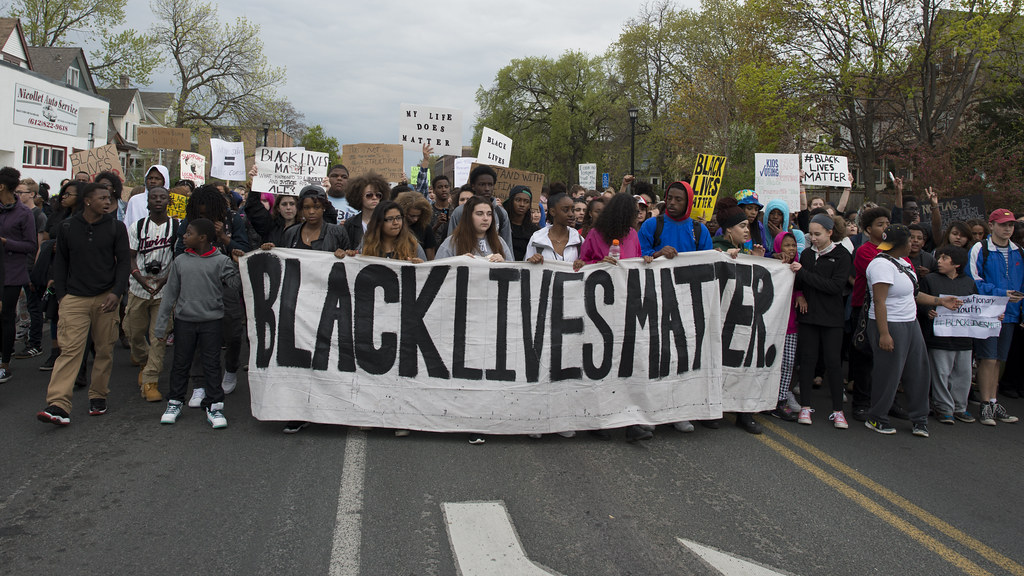
I’m convinced that the same awakening is overdue from folks who are hesitant to call themselves supporters of Black Lives Matter.

If you are unsure about how clearly or loudly to voice your support, or whether to voice your support at all, review the following Black Lives Matter Guiding Principles from their official webpage (http://blacklivesmatter.com/guiding-principles/) and ask yourself what it means to not support Black Lives Matter. In short, it means that you disagree with or do not stand for the following:
  • Empathy: We are committed to practicing empathy; we engage comrades with the intent to learn about and connect with their contexts.
  • Loving Engagement: We are committed to embodying and practicing justice, liberation, and peace in our engagements with one another.
  • Diversity: We are committed to acknowledging, respecting and celebrating difference(s) and commonalities.
  • Restorative Justice: We are committed to collectively, lovingly and courageously working vigorously for freedom and justice for Black people and, by extension all people. As we forge our path, we intentionally build and nurture a beloved community that is bonded together through a beautiful struggle that is restorative, not depleting.
  • Globalism: We see ourselves as part of the global Black family and we are aware of the different ways we are impacted or privileged as Black folk who exist in different parts of the world.
  • Collective Value: We are guided by the fact that all Black lives, regardless of actual or perceived sexual identity, gender identity, gender expression, economic status, ability, disability, religious beliefs or disbeliefs, immigration status or location.
  • Black Villages: We are committed to disrupting the Western-prescribed nuclear family structure requirement by supporting each other as extended families and “villages” that collectively care for one another, and especially “our” children to the degree that mothers, parents and children are comfortable.
  • Black Families: We are committed to making our spaces family-friendly and enabling  parents to fully participate with their children. We are committed to dismantling the patriarchal practice that requires mothers to work “double shifts” that require them to mother in private even as they participate in justice work.
  • Intergenerational Involvement: We are committed to fostering an intergenerational and communal network free from ageism. We believe that all people, regardless of age, show up with capacity to lead and learn.
  • Transgender Affirming: We are committed to embracing and making space for trans brothers and sisters to participate and lead. We are committed to being self-reflexive and doing the work required to dismantle cis-gender privilege and uplift Black trans folk, especially Black trans women who continue to be disproportionately impacted by trans-antagonistic violence.
  • Queer Affirming: We are committed to fostering a queer‐affirming network. When we gather, we do so with the intention of freeing ourselves from the tight grip of heteronormative thinking or, rather, the belief that all in the world are heterosexual unless s/he or they disclose otherwise.
  • Unapologetically Black Positioning: We are unapologetically Black in our positioning. In affirming that Black Lives Matter, we need not qualify our position. To love and desire freedom and justice for ourselves is a necessary prerequisite for wanting the same for others.

Forget the diversion of focusing on the few individuals who misrepresent the movement, because sadly, every worthy movement has those.

If you support these principles, the time to act is now. Share something (like this piece you're reading), join something (like this organization: http://www.showingupforracialjustice.org/), wear something (like this shirt: https://blckstore.org/products/blcklives-awareness-t-shirt-unisex), or go somewhere (like this meeting: https://www.facebook.com/events/1305318102811984/) and show that you agree with making an ideological and political intervention in a world where Black lives are systematically devalued. All lives do matter, so let’s unequivocally voice that Black Lives Matter to us, too.

Image result for white people for black lives


Monday, July 4, 2016

Topic #5: Imposter Syndrome and White Silence

Topic #5: Imposter Syndrome and White Silence.
This article was published in Elephant Journal. Please click here to read it.